
THRIVEair was a community-responsive air monitoring in South/Southwest Philadelphia, through a partnership between Drexel University and Philly Thrive, a local environmental justice organization.
Study Design
THRIVEair was a one-year air monitoring campaign that scientists and community members co-designed. That means that we worked together to decide which types of air pollution to measure, and where to measure it. As a result of this planning, we measured volatile organic compounds (VOCs) in the air for one year from June 2023 to June 2024.
Through this co-design process, we found that community members were concerned about pollution from traffic, and pollution coming from the former Philadelphia Energy Solutions refinery site, which is now in the process of getting re-developed into a warehousing and life sciences district. We chose monitoring sites based on trying to find out the contribution of those sources to air pollution in our study area.
A quick note: We also planned to monitor for fine particulate matter (PM2.5), but due to logistical issues we weren’t able to get enough information on particulate matter for a full data analysis. That’s why you’ll see information about PM2.5 monitoring on this page, but not on the results.
Where did we set up the air monitors?
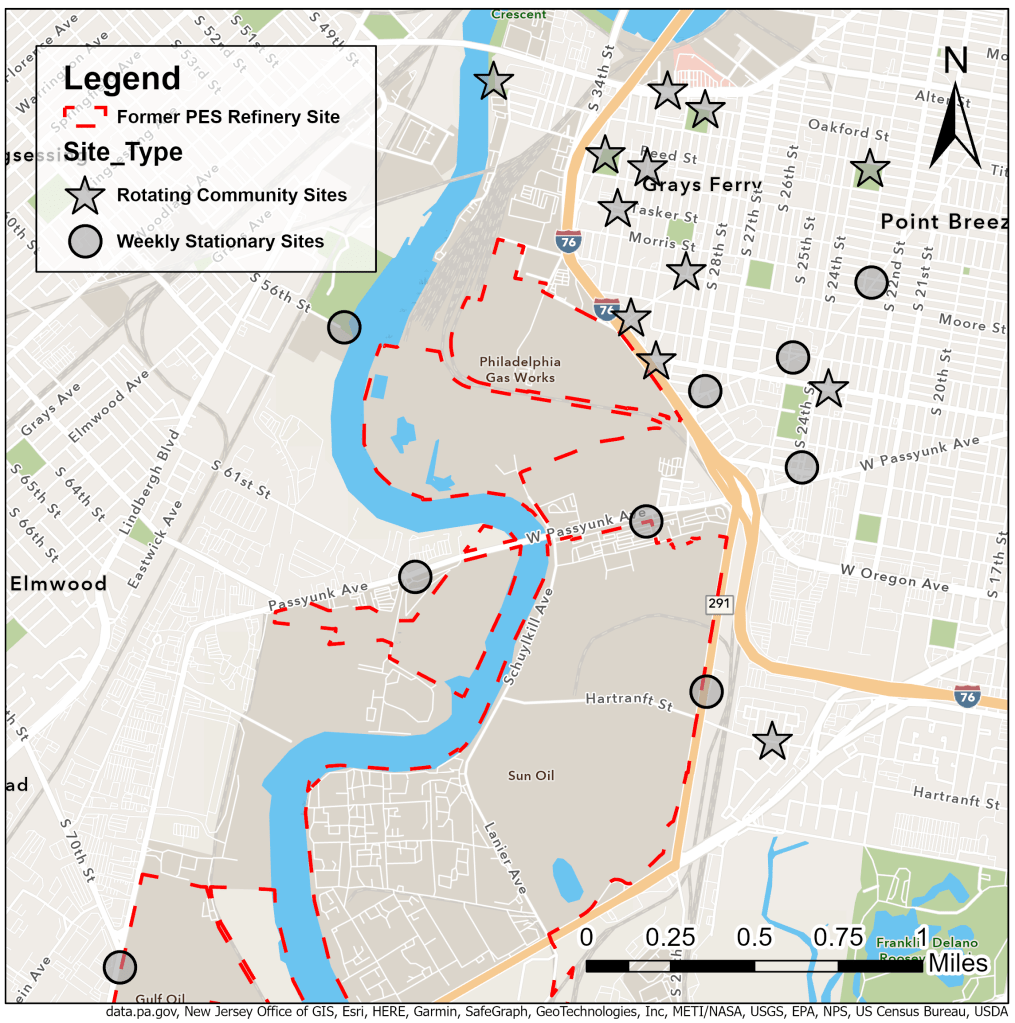
This map shows THRIVEair monitor locations.
“Weekly stationary sites” were monitored every week for the whole year, while “rotating community sites” were each monitored for a total of four weeks, rotating through the sites in sets of 3. We used this study design due to cost and time limitations.
What kind of pollution did we measure?
THRIVEair focused on two major groups of air pollutants:
- Volatile Organic Compounds (VOCs)
- Particulate matter with a diameter smaller than 2.5 µm (PM2.5)
1. VOCs
Volatile Organic Compounds (VOCs) are a group of chemicals that evaporate in the air easily (they are “volatile”). There are many chemicals that are VOCs, but we are focusing on benzene and similar compounds because they are especially harmful to health.
For more on VOCs, check out the American Lung Association’s webpage
2. PM2.5
PM2.5 refers to tiny particles in the air with diameters smaller than 2.5 microns. That’s about 20 times smaller than the width of a human hair and 36 times smaller than a grain of sand.

These tiny particles come from automobile exhaust and industrial sources, and can lead to health problems like asthma and heart disease. We will measure the total amount of these particles, and determine which metals are present in the particles.
For more on PM2.5, check out the EPA’s webpage
What kind of air monitors did we use?
We used two types of air monitor devices to measure the two types of pollution described above. You might have seen both monitors hanging on the same telephone pole, or just one at a time.
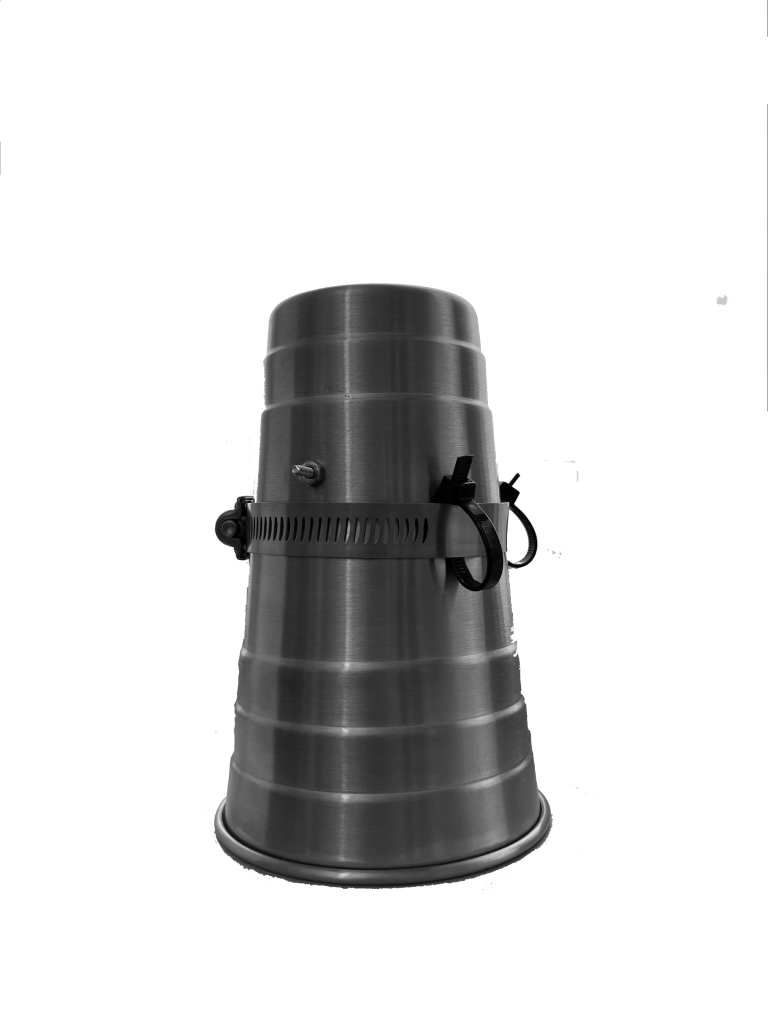
1. VOC Monitor
Inside this metal housing is a tube that catches Volatile Organic Compounds (VOCs) in the air.
We collected these tubes weekly and measure how much of each kind of VOC they captured that week.

2. PM2.5 Monitor
These boxes are air monitors called Ultrasonic Personal Air Samplers (UPAS). They measure tiny particles (also called fine particulate matter or PM2.5) in the air.
Our goal was to collect filters from these devices every two weeks and weigh them to see how the total amount of particles collected, and then send them out for additional analysis to measure metals (like lead) in the air. Unfortunately, we had a lot of issues getting enough solar power to the devices and we didn’t end up getting enough good-quality information to get a full set of results for fine particulate matter.
Results: What did we find?
For results, including interactive maps and downloadable fact sheets, see our Results page. We also hosted a few public-facing community events to share our results. Finally, we also have two academic papers in the works, which we’ll share on here once they go through peer review.
 THRIVEair